 We have talked about patterns that may be constructed by having several tiles to choose from and the cool interlocking looks that come from that. We have even started talking about the grammar of tiles and the kinds of changes to the tiling patterns that come from even-odd rules.
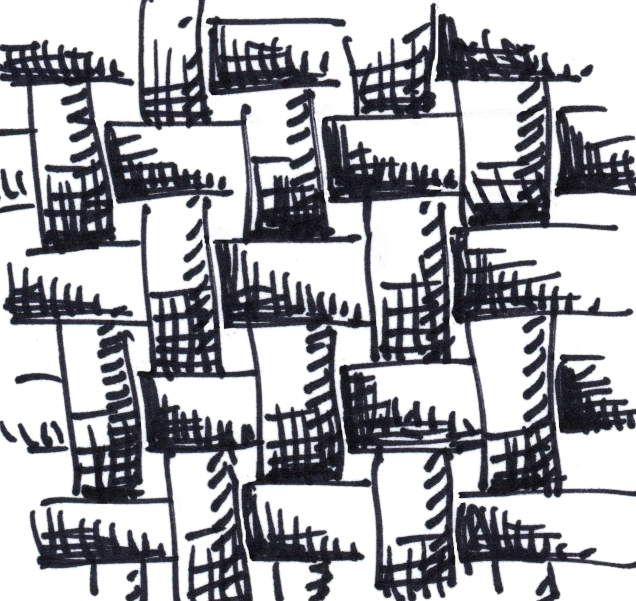
For instance, a simple plainweave uses an even-odd rule.
And this is the most common form of interlock. Plainweave is the basis of modern cloth and thus clothing. Weaving was discovered millennia ago, and is still done today by handcraft artists and by full-scale Jacquard looms in factories as well, worldwide.
Some interlock was designed as a symbol of the gods, like the viking Valknut, the predecessor of the modern trefoil knot and also of the Borromean rings.
 I have constructed a Valknut out of the basis for an impossible figure I used to sketch when I was a kid. This interlocking figure is called unicursal because in its simplest form, it can be drawn from one unbroken line, if you ignore that it must pass in front of and behind itself, of course. And this shows the even-odd rule in is most primitive form. Each time we cross over, we alternate going over and under.
The plainweave also does this, but in a regular manner. If you number each row (weft) and each column (warp), then you can see that the warp passes over on each location where the row number plus the column number adds up to an even number, and the weft passes over when the sum is odd.
 The Valknut, of course, it the predecessor of the trefoil knot, which is sometimes known as the love-knot. This is in a direct conflict with the original meaning of the Valknut, which is as a symbol of Odin's patronage of the valiant fighters who die in battle.
Still, to me, the trefoil means an endless connection. Something continuous and intertwined, even entangled. Metacreations used a trefoil knot for their logo at first, until it was replaced by an uninteresting and uncreative logo by the new CEO.
I think I prefer to remember the trefoil as an endless connection.
 A second form of Valknut is organized like interlocking Borromean rings, but with triangles. This shows the basic interlock, which also follows the even-odd rule scrupulously.
A very tight version of this occurs on various viking-era runestones, such as the Stora Hammar stone and the Tängelgårda stone in Lärbro, Gotland.
I am a bit of a fan of runestones. I have visited the large Jelling stone, in Jelling, Denmark and wondered at its intertwining, which dates from the tenth century. It contains several trefoil knots.
Actually the vikings did influence a lot of art that contains intertwining. It's possible they had their influence on the famous Book of Kells, housed in Trinity College, Dublin, Ireland.
 I have shown that we can construct patterns from rectangular pieces that we piece together like a jigsaw puzzle. Here again, the even-odd rule helps us create a standard interlocking pattern line plainweave.
On a two-dimensional lattice, the even-odd rule is exemplified by the checkerboard.
Interlocking figures in 3D are not hard to come by. I have drawn one here and I reproduce it at a larger scale now. It shows three interlocking slabs. If each slab is actually constructed of a 1x3x5 form factor, with a 1x1x3 hole in the center of it, then they should just fit together, leaving a 1x1x1 void in the center.
 The original version of this I drew while bored in a Metacreations management meeting where we were discussing a highly relevant problem. I found it on the back of a sheet of copy paper with the reverse side inscribed with ideas for improvements on the "MetaWorlds" family of products. These included Kai's Power Goo, Kai's Photo Soap, etc. Some of my best drawings are on the back of that page!
I have also been interested in the interlocking logotype. This interest has led me to produce interlocking forms for P4 and P5 (symbols for Painter 4 and Painter 5). One of them got reproduced in the Painter 4 manual.
I implemented this logotype in mosaics and it was definitely influenced by medieval letterforms.
 The P4 logotype might have been a little bit different, but it certainly got its point across. Our theme for Painter 4, Painter Through The Ages, was the inspiration for this creation.
Also, the royal monogram for Danish king Christian the Fourth caught my eye one day when visiting the Domkirche at Roskilde, Denmark.
The construction of logotypes and monograms is a cool art. It is still in use today and practitioners of the art can be found at all design studios.
Interlock is still something that stirs people's imaginations. The Lego toys are the best way to get started thinking about interlocking and its application to building.
Even today, science is fascinated with interlocking. In particular quantum entanglement is a classic expression of interlock. Two photons become entangled: their quantum states become interlocked. Even when they are separated, they continue to interlock: when you change the quantum state of one, the other's quantum state must also change to match.
Perhaps interlock is built into the very fabric of space-time.
